
Download
L O D = − 3 S a b , and L O Q = 10 S a b , 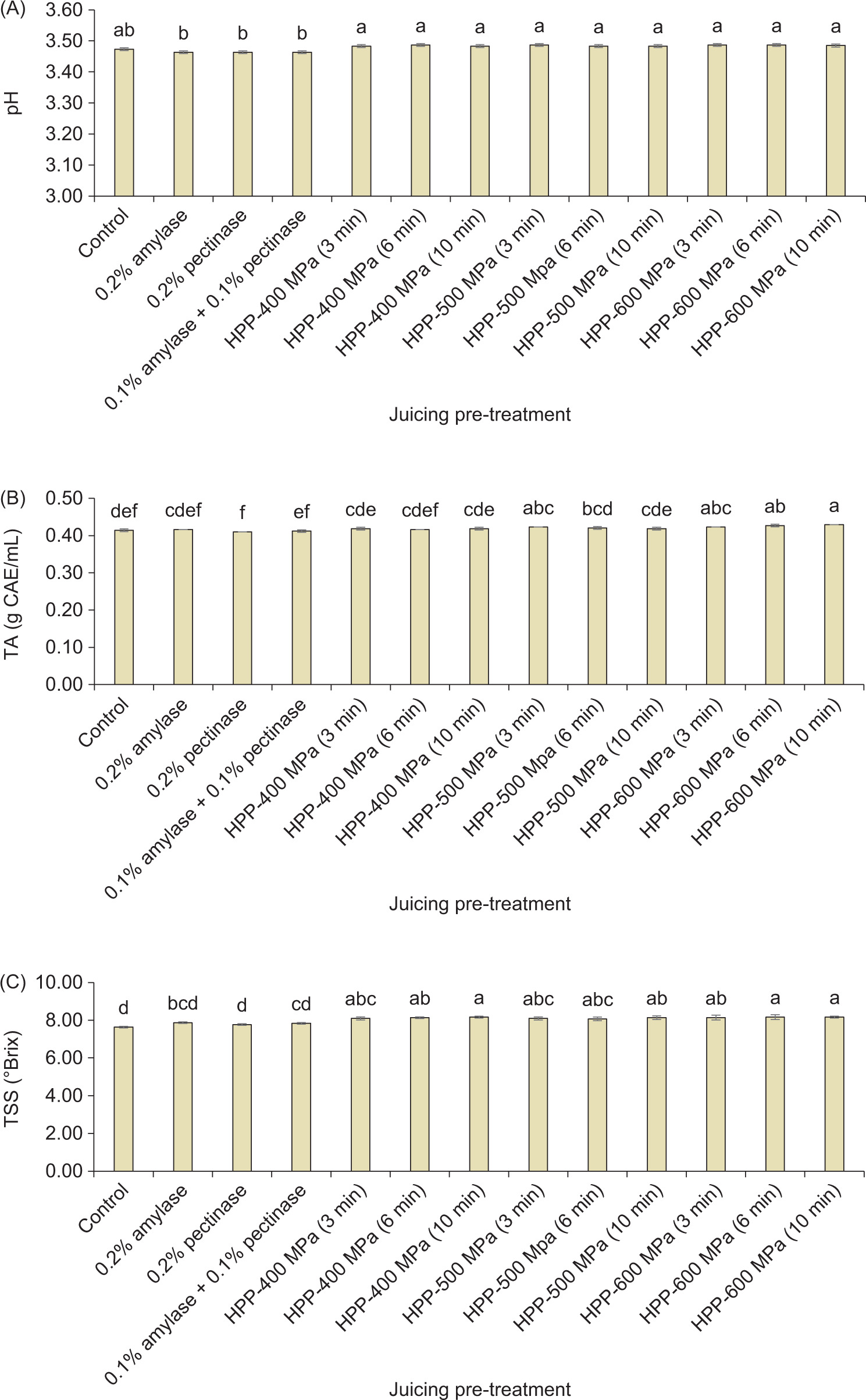



ORIGINAL ARTICLE
Comparative evaluation of high-pressure processing and enzyme maceration as innovative nonthermal pre-treatments in jaboticaba juice production
Nor Azwan Haniff Kamarol Zaman1,2, Giroon Ijod1, Nur Izzati Mohamed Nawawi1, Nur Addina Mohamad Rosli1, Chong Gun Hean1, Noranizan Mohd Adzahan1, Ezzat Mohamad Azman1*
1Department of Food Technology, Faculty of Food Science and Technology, Universiti Putra Malaysia, Serdang, Selangor 43400, Malaysia;
2Agro-Biotechnology Institute Malaysia (ABI), Jalan Bioteknologi, Serdang, Selangor, Malaysia
Abstract
Jaboticaba (Myrciaria jaboticaba) is a polyphenol-rich fruit, particularly abundant in anthocyanins concentrated within its thick peel, which exhibits potent antioxidant activity. Owing to the thermal sensitivity of these compounds, nonthermal processing techniques, such as high-pressure processing (HPP) and enzymatic maceration, were compared to enhance anthocyanin extraction while minimizing degradation. In this study, whole jaboticaba fruits were subjected to HPP at 400, 500, and 600 MPa for 3, 6, and 10 min, while enzymatic maceration was performed using 0.2% amylase, 0.2% pectinase, and a combination of 0.1% amylase + 0.1% pectinase (v/w) at 50 ± 1°C for 30 min. Treatment with 0.2% amylase significantly (p < 0.05) increased total anthocyanin content, total phenolic content, and antioxidant activity while effectively reducing residual polyphenol oxidase activity. Conversely, HPP at 600 MPa for 6–10 min significantly decreased peroxidase activity, whereas the 400 MPa (3 min) treatment yielded the highest total sugar content. Among the HPP treatments, the highest total anthocyanin content was recorded at 400 MPa, suggesting that moderate pressure, regardless of holding time, enhances anthocyanin release from the fruit matrix. Overall, these findings demonstrate that both HPP and enzymatic maceration are promising nonthermal pre-treatment strategies for improving anthocyanin recovery, antioxidant capacity, and enzymatic stability in jaboticaba juice, thereby contributing to the development of high-quality, minimally -processed functional beverages.
Key words: amylase, anthocyanins-rich juice, anthocyanins stability, antioxidant activity, nonthermal juicing -pre-treatment, residual enzyme activity
*Corresponding Author: Ezzat Mohamad Azman, Department of Food Technology, Faculty of Food Science and Technology, Universiti Putra Malaysia, Serdang, Selangor 43400, Malaysia. Email: ezzat@upm.edu.my
Academic Editor: Prof. Simone Vincenzi, University of Padova, Italy
Received: 26 October 2025; Accepted: 9 February 2026; Published: 1 April 2026
© 2026 Codon Publications
This is an Open Access article distributed under the terms of the Creative Commons Attribution-NonCommercial-ShareAlike 4.0 International (CC BY-NC-SA 4.0). License (http://creativecommons.org/licenses/by-nc-sa/4.0/)
Introduction
Jaboticaba (Myrciaria jaboticaba), a berry native to Southeastern Brazil and a member of the Myrtaceae family, has attracted considerable attention for its appealing sensory qualities and rich phytochemical composition. Approximately one-third of the fruit comprises peel and two-thirds pulp and seeds, with the peel notably thicker than that of grapes. The pulp possesses a sweet, mildly acidic, jelly-like texture (Chua et al., 2023), and is rich in essential minerals, vitamins, dietary fiber, organic acids, sugars, and polyphenols. The peel, in particular, contains abundant phenolic compounds, such as ellagic acid, tannins, and anthocyanins (Ramos Boldori et al., 2023), which are known for their antioxidant, anti--inflammatory, lipid-lowering, and antimicrobial properties (Fernandes et al., 2020).
Despite its exceptional nutritional and functional value, the commercialization of fresh jaboticaba remains limited due to its high perishability and short postharvest life. To reduce losses and increase market potential, jaboticaba is often processed into value-added products, such as jams, juices, vinegars, and fermented beverages (Inada et al., 2021). Among its bioactives, anthocyanins, particularly delphinidin-3-O-glucoside (D3G) and cyanidin-3-O--glucoside (C3G), are the key pigments responsible for its deep purple color and strong antioxidant capacity (Fernandes et al., 2022). However, these compounds are highly sensitive to environmental and processing factors, such as temperature, pH, oxygen exposure, and enzymatic oxidation, which accelerate their degradation and limit their functional stability (Azman et al., 2022).
Juice production provides a practical means of extending jaboticaba’s shelf life while retaining its nutritional and biofunctional properties (Geraldi et al., 2021). Nevertheless, the fruit’s thick peel and robust cell wall structure hinder the efficient extraction of anthocyanins and phenolics through conventional juicing. Overcoming this structural barrier requires pre-treatment strategies that can enhance cell wall disruption and facilitate the release of bioactive compounds (Marquetti et al., 2018).
High-pressure processing (HPP) subjects food matrices to pressures of 100–600 MPa, promoting cell membrane permeabilization and enhanced mass transfer without substantial thermal input. The effects of HPP on endogenous enzymes are highly enzyme--dependent and influenced by processing conditions; while certain oxidative enzymes, such as polyphenol oxidase (PPO) and peroxidase (POD), may be partially or fully inactivated under specific pressure–time combinations, others may retain activity or undergo reversible conformational changes. Nevertheless, when appropriately optimized, HPP can contribute to improved extractability of bioactive compounds while minimizing thermal degradation of vitamins, pigments, and phenolics, supporting its application in minimally processed functional beverages (Abera, 2019; Barba et al., 2015; Jamaluddin et al., 2022). Conversely, enzymatic maceration utilizes hydrolytic enzymes, such as amylase and pectinase, to degrade structural polysaccharides and pectic substances, thereby loosening the cell wall and promoting the release of intracellular compounds. This method also allows modulation of key juice characteristics, including yield, viscosity, and clarity (Paludo et al., 2019).
Therefore, this study aims to evaluate and compare the efficacy of HPP and enzymatic maceration as sustainable, nonthermal pre-treatment strategies for producing jaboticaba juice. The work focuses on improving anthocyanin release, phenolic content, antioxidant activity, and enzymatic inactivation while employing multivariate analyses (principal component analysis [PCA] and correlogram) to elucidate interrelationships among physicochemical and bioactive parameters. The outcomes of this study contribute to the scientific foundation for green, low-carbon processing technologies that enhance food quality, minimize waste, and advance the United Nations Sustainable Development Goals (SDGs 2, 9, 12, and 13).
Materials and Method
Chemicals
Cyanidin-3-O-glucoside and D3G were -purchased from Extrasynthese, France. Folin reagent, 2,2-diphenyl-1-picrylhydrazyl (DPPH), and other chemicals and solvents of analytical grade were obtained from Fisher Scientific (Leicestershire, UK). Pectinase Ultra SP-L and α-amylase were purchased from Novo Nordisk Ferment Ltd., Dittigen, Switzerland and Novozymes, Denmark, respectively.
Sample preparation
Jaboticaba fruits of the commercial maturity stage (fully purple in color) were obtained from a local farm in Senai, Johor, Malaysia. Prior to analysis, the fruits were cut in half and subjected to steam blanching at 100°C for 1 min.
Nonthermal juicing pre-treatment methods
High-pressure processing
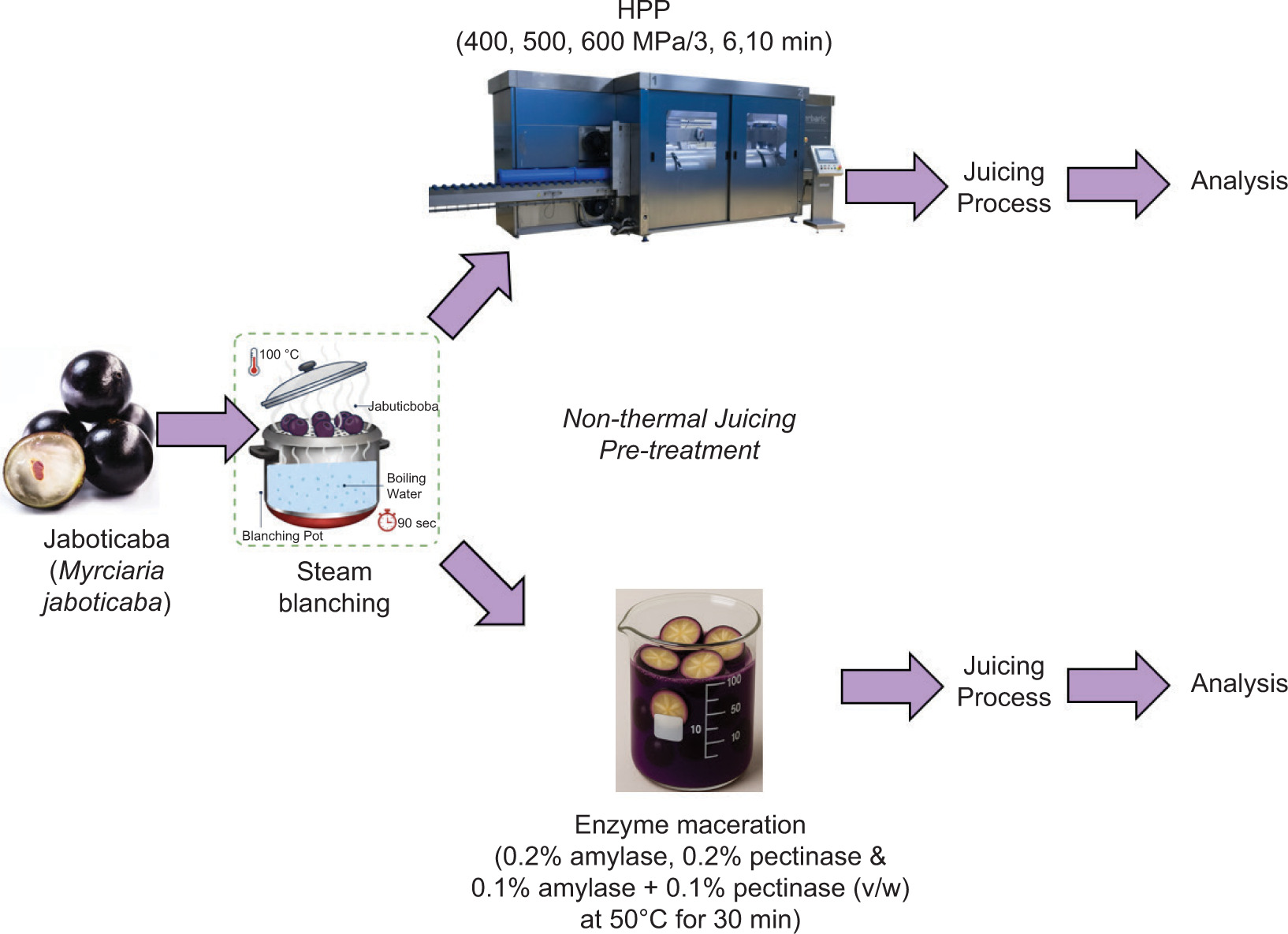
Approximately 200 g of blanched jaboticaba fruits were manually cut into half pieces to optimize substrate–enzyme contact and packed in multilayer packaging material (polypropylene–aluminium foil–polyethylene) prior to treatment. HPP pre-treatments were conducted at 400, 500, and 600 MPa for 3, 6, and 10 min at 25 ± 1°C using a 55-L capacity HPP unit (Hiperbaric; Burgos, Spain) located at the Faculty of Food Science and Technology, Universiti Putra Malaysia, Malaysia (Figure 1). Following the treatment, jaboticaba juice was extracted using a high-speed juicer (Panasonic, Model MJ-70M; Malaysia) for further analyses.
Figure 1. Flow chart of nonthermal pre-treatment methods for producing jaboticaba juice.
Enzyme maceration
In all, 200 g of blanched jaboticaba was macerated using 0.2% pectinase, 0.2% amylase, or a mixture of 0.1% pectinase and 0.1% amylase (v/w). The fruits were incubated with enzyme solutions at 50 ± 1°C for 30 min (Figure 1). Subsequently, the jaboticaba juice was extracted using a high-speed juicer (Panasonic, Model MJ-70M) for -further analyses.
Determination of pH, titratable acidity (TA), and total soluble solids (TSS)
pH value, TA, and TSS were determined according to Ismail et al. (2024) . The pH was measured using a pH meter (Mettler-Toledo, Model SevenEasy pH; Switzerland). Total TA was determined by titration with 0.1 mol/L NaOH to an endpoint pH of 8.2–8.4, and the results were expressed as grams of citric acid equivalent per millilitre (g CAE/mL). TSS was -measured using a refractometer (ATAGO, Japan) and expressed in °Brix.
Quantification of anthocyanins using high-performance liquid chromatography (HPLC)
The HPLC analysis of anthocyanin compounds was based on the method described by Ijod et al. (2025). Mobile phase consisted of 2% (v/v) formic acid (solvent A) and 100% (v/v) methanol (solvent B). The gradient elution profile was as follows: 15% (solvent B) at 0 minute, increasing to 35% (solvent B) at 15 minutes, 60% (solvent B) at 30 minutes, and reaching 80% (solvent B) at 40 minutes. The analysis utilized a Purospher STAR RP18 end-capped column (250 mm × 4.6 mm inner diameter [i.d.], with a particle size of 5 μm; Merck, Darmstadt, Germany) within a Waters 2695 Alliance HPLC system (Waters Corp., Milford, MA, USA). This system was equipped with a two-channel ultraviolet (UV) detector (Waters 2478), two HPLC pumps (Waters 515), an auto-sampler, a column oven, and an online degasser. The column temperature was set at 30°C, and the flow rate was kept constant at 1.0 mL/min. The analysis took 45 min overall, with an injection volume of 20 μL. For anthocyanins at 520 nm, calibration curves covering concentration ranges of 10–100 mg/L were created using external standards. The following formula was used for the limit of quantification (LOQ), limit of detection (LOD), standard deviation (Sa) and b (slope):
where Sa represents the standard deviation of the y-intercepts obtained from replicate calibration curves (reflecting baseline noise and instrumental variability), and b denotes the slope of the calibration curve, which describes the analytical sensitivity of the method. The numerical factors 3 and 10 correspond to signal-to-noise ratios of approximately 3:1 and 10:1 for LOD and LOQ, respectively, ensuring reliable detection and accurate quantification of anthocyanins.
Determination of total phenolic content (TPC)
The TPC was determined according to the method described by Ijod et al. (2025). The mixture was incubated for 2 h at room temperature, and the absorbance was measured at 765 nm using a spectrophotometer (Optizen POP QX, Mecasys, South Korea). A calibration curve was prepared using gallic acid (GAE, 0–100 mg/L) as the standard. Results were expressed as milligrams of GAE equivalent per 100 mL of juice (mg GAE/100 mL).
Determination of residual enzyme activities of polyphenol oxidase and peroxidase
The PPO and POD activities were determined according to the method described by Ijod et al. (2024). Increase in absorbance at 420 nm and 480 nm was monitored to measure PPO and POD enzymatic activities, respectively. The residual PPO and POD activities were calculated subsequently.
Determination of antioxidant activities
Trolox equivalent antioxidant capacity (TEAC)
The TEAC activity was determined by following the method described by Nawawi et al. (2025) with minor modifications. The mixture was incubated in the dark at 30°C for 30 min, after which the absorbance was measured at 517 nm using a spectrophotometer (Optizen POP QX). Results were expressed as micromoles of Trolox (TE) equivalent per 100 mL of juice (µmol TE/100 mL). Mean values were calculated from duplicate measurements.
Determination of ferric reducing antioxidant power (FRAP)
The FRAP assay was conducted according to the method described by Ismail et al. (2024). The absorbance was measured at 595 nm using a spectrophotometer (Optizen POP QX). A Trolox calibration curve (0–2,000 µM) was used for quantification, and results were expressed as µmol TE/100 mL of juice.
Total sugar content
Sugar compositions, including glucose, fructose, and sucrose, were analyzed using HPLC (Waters Corp.) according to the method described by Dasaesamoh et al. (2016). The mobile phase, consisting of 80% acetonitrile in water, was delivered at a flow rate of 1.2 mL/min. Separation and quantification was performed using a Purospher STAR NH2 end-capped column (5 µm particle size, 250 mm × 4.6 mm i.d.). The HPLC system comprised a column oven, an online degasser, an autosampler, two Waters 515 pumps, and a refractive index (RI) detector. The injection volume was 20 µL, and the column temperature was maintained at 40°C. Calibration curves for glucose, fructose, and sucrose were prepared within the concentration range of 1.0–3.0 mg/mL. Sugar contents were expressed as milligrams per 100 mL of juice (mg/100 mL).
Statistical analysis
Data were analyzed using One-way Analysis of Variance (ANOVA) with a significance level of 95% (p < 0.05). Data were expressed as mean ± standard deviation. Correlations between the tested analysis and parameters were determined by using the correlogram and (PCA) through the Minitab version 21.4 software (Minitab Inc., PA, USA).
Results and Discussion
pH, TA, and TSS
As shown in Figure 2A, enzymatic maceration resulted in a slight but statistically significant reduction in pH compared with HPP-treated samples (p < 0.05). While this pH decrease may be associated with the enzymatic disruption of plant cell wall structures, it cannot be conclusively attributed to polysaccharide hydrolysis alone. Enzymatic maceration may facilitate the release of pre-existing organic acids (e.g., citric acid and malic acid) that are bound or compartmentalized within the pectin-rich middle lamella and vacuolar regions, thereby increasing the concentration of dissociated acids in the medium (Jia et al., 2023; Yilmaz et al., 2019).
Figure 2. Effect of different juicing pre-treatments using high-pressure processing (HPP) and enzyme maceration on the pH, titratable acidity (TA), and total soluble solids (TSS) of jaboticaba juice.
Alternatively, the observed pH reduction may partly reflect microbial activity during enzymatic maceration, leading to the production of organic acids as metabolic by-products. This hypothesis is supported by the absence of a similar pH decrease in HPP-treated samples, as HPP is known to be highly effective in inactivating vegetative microorganisms in acidic fruit matrices. In contrast, enzymatic maceration is typically conducted under milder conditions that may permit limited microbial survival or growth if not coupled with an effective microbial inactivation step.
As microbial analyses were not conducted in the present study, the relative contribution of enzymatic effects versus microbial metabolism to the observed pH changes cannot be definitively distinguished. Future work incorporating microbial enumeration or sterilization controls (e.g., blanching or antimicrobial treatments prior to enzymatic maceration) would be necessary to clarify the underlying mechanisms.
High-pressure processing induced extensive disruption of cellular structures beyond the middle lamella, releasing intracellular buffering components (proteins, potassium ions, and weak bases) that may neutralize free protons, slightly increasing pH (Dhenge et al., 2023). Consistent with this, Yang et al. (2022) reported minimal change in pH (≈0.06 units) in 400 MPa-treated fruit purées, confirming that HPP exerts only minor effects on acidity.
No significant differences were observed in TA between enzyme- and HPP-treated samples (p > 0.05; Figure 2B). TA reflects the total concentration of proton-donating acids, primarily citric acid, malic acid, and tartaric acid, which are relatively stable under both nonthermal treatments. HPP preserves organic acids by avoiding heat-induced degradation, while enzyme maceration mainly hydrolyzes polysaccharides rather than organic acids (Marsol-Vall et al., 2021). These results agree with Yuan et al. (2018), who observed unchanged TA in aronia purée treated at 200–600 MPa.
As illustrated in Figure 2C, TSS increased progressively with HPP intensity, whereas enzymatic treatments had a less pronounced effect. The mechanical rupture caused by HPP promotes the diffusion of soluble constituents (sugars, organic acids, and minerals) from disrupted cells into the juice matrix (Barba et al., 2015). In contrast, pectinase activity during enzyme maceration is more selective, primarily degrading pectin without affecting cellulose or lignin (Li et al., 2021), thus leading to modest TSS enhancement. Collectively, pH, TA, and TSS were not significantly correlated, confirming that HPP and enzyme maceration act through distinct mechanisms of cell wall modification and solute diffusion.
Residual enzyme activity
Enzymatic pre-treatment with 0.2% amylase achieved the greatest reduction in PPO activity (≈63.5%), followed by the combined enzyme treatment (≈69.5%) and HPP (≈72.4%) (Figure 3A). This pronounced effect of amylase stems from its ability to hydrolyze starch and other polysaccharides, leading to substantial cell wall disintegration and increased exposure of PPO to denaturing conditions (Wang et al., 2022). The combined amylase and pectinase treatment produced milder disruption because pectinase primarily hydrolyzes pectic substances, rather than starch, explaining the slightly higher residual PPO activity (Tapre and Jain, 2014). HPP was less effective in reducing PPO activity under the tested pressure, as complete inactivation generally requires pressure of above 800 MPa (González-Cebrino et al., 2013). Although HPP disrupts membranes and alters protein conformation (Sehrawat et al., 2021), PPO’s tertiary structure remains partly intact at ≤600 MPa.
Figure 3. Effect of different juicing pre-treatments using HPP and enzyme maceration on the residual enzyme activity of -jaboticaba juice. REA: residual enzyme activity; PPO: polyphenol oxidase; POD: peroxidase; HPP: high-pressure processing.
In contrast, POD was more pressure sensitive. POD activity declined significantly (p < 0.05) at 500–600 MPa, with maximum inactivation at 600 MPa for 6–10 min. This effect reflects disruption of hydrogen bonds and hydrophobic interactions stabilizing the enzyme’s active conformation (Liu et al., 2024; Marszałek et al., 2019). Enzymatic maceration exerted limited influence on POD because it mainly affects structural polysaccharides, rather than enzyme conformation. A strong correlation between PPO and POD residual activities (r = 0.975 for enzyme-treated, r = 0.851 for HPP samples) indicates a coordinated oxidative response to processing. Overall, these results confirm that HPP effectively inactivates POD, while amylase-based maceration more strongly reduces PPO, supporting their complementary potential in nonthermal juice stabilization strategies aligned with SDG 9 (Innovation in Food Processing) and SDG 12 (Responsible Production).
Anthocyanin content using HPLC
As summarized in Table 1, 0.2% amylase treatment yielded the highest total anthocyanin content (43.50 mg/100 mL), with C3G (≈75.8%) predominating over D3G (≈24.2%) (p < 0.05). The enhanced recovery results from enzymatic hydrolysis of starch and pectin, which loosens cell wall structures and liberates vacuolar pigments (de Barros et al., 2024; Ijod et al., 2024). Amylase effectively disrupts anthocyanin–polysaccharide complexes, reducing pigment entrapment and improving diffusion into the aqueous phase (Zhang et al., 2024). Pectinase, in contrast, acts mainly in the middle lamella and contributes moderately to the release of anthocyanin (Daher and Braybrook, 2015).
Table 1. Anthocyanin composition of jaboticaba juice after different juicing pre-treatments using high-pressure processing (HPP) and enzyme maceration as quantified by HPLC.
| Extraction pre-treatment | Anthocyanins (mg/100 mL) | ||
|---|---|---|---|
| D3G | C3G | Total | |
| Control | <LOQ | 22.33 ± 0.04b | 22.33 ± 0.04c |
| 0.2% Amylase | 10.52 ± 0.51a | 32.98 ± 0.25a | 43.50 ± 0.76a |
| 0.2% Pectinase | 9.42 ± 0.48a,b | 30.38 ± 0.94a | 39.80 ± 1.42b |
| 0.1% Amylase + 0.1% pectinase | 8.67 ± 0.39b | 30.50 ± 0.91a | 39.17 ± 1.30b |
| HPP-400 MPa (3 min) | <LOQ | 17.64 ± 0.49c | 17.64 ± 0.49d |
| HPP-400 MPa (6 min) | <LOQ | 14.06 ± 0.55d | 14.06 ± 0.55e |
| HPP-400 MPa (10 min) | <LOQ | 14.67 ± 0.26d | 14.67 ± 0.26d,e |
| HPP-500 MPa (3 min) | <LOQ | 10.11 ± 1.06e,f | 10.11 ± 1.06f |
| HPP-500 MPa (6 min) | <LOQ | 10.28 ± 0.20e | 10.28 ± 0.20f |
| HPP-500 MPa (10 min) | <LOQ | 8.80 ± 0.48e,f | 8.80 ± 0.48f |
| HPP-600 MPa (3 min) | <LOQ | 7.69 ± 1.00e,f | 7.69 ± 1.00f |
| HPP-600 MPa (6 min) | <LOQ | 10.24 ± 0.08e | 10.24 ± 0.08f |
| HPP-600 MPa (10 min) | <LOQ | 7.56 ± 1.02f | 7.56 ± 1.02f |
Notes: Values with the same superscript alphabetsa–f in each row are not significantly different (p < 0.05).
D3G: delphinidin 3-O-glucoside; C3G: cyanidin 3-O-glucoside; LOQ: limit of quantification; HPLC: high-performance liquid chromatography.
The HPP-treated samples showed markedly lower anthocyanin content. Only C3G was detected, with D3G below the quantification limit across all pressure levels. C3G decreased progressively with higher pressure and longer holding period, with 400 MPa treatments showing the best retention. Decline at elevated pressures probably results from pigment degradation and disruption of stabilizing complexes under high shear and oxidative conditions (Enaru et al., 2021; Marszałek et al., 2017). Comparable results were reported by Guo et al. (2024) for mulberry juice, where anthocyanin degradation increased beyond 400 MPa. Collectively, these findings indicate that enzyme-assisted maceration (especially amylase) maximizes pigment recovery, while moderate HPP (~400 MPa) better preserves the existing anthocyanins, supporting the design of low-energy, pigment-stabilizing juicing processes.
Total phenolic content
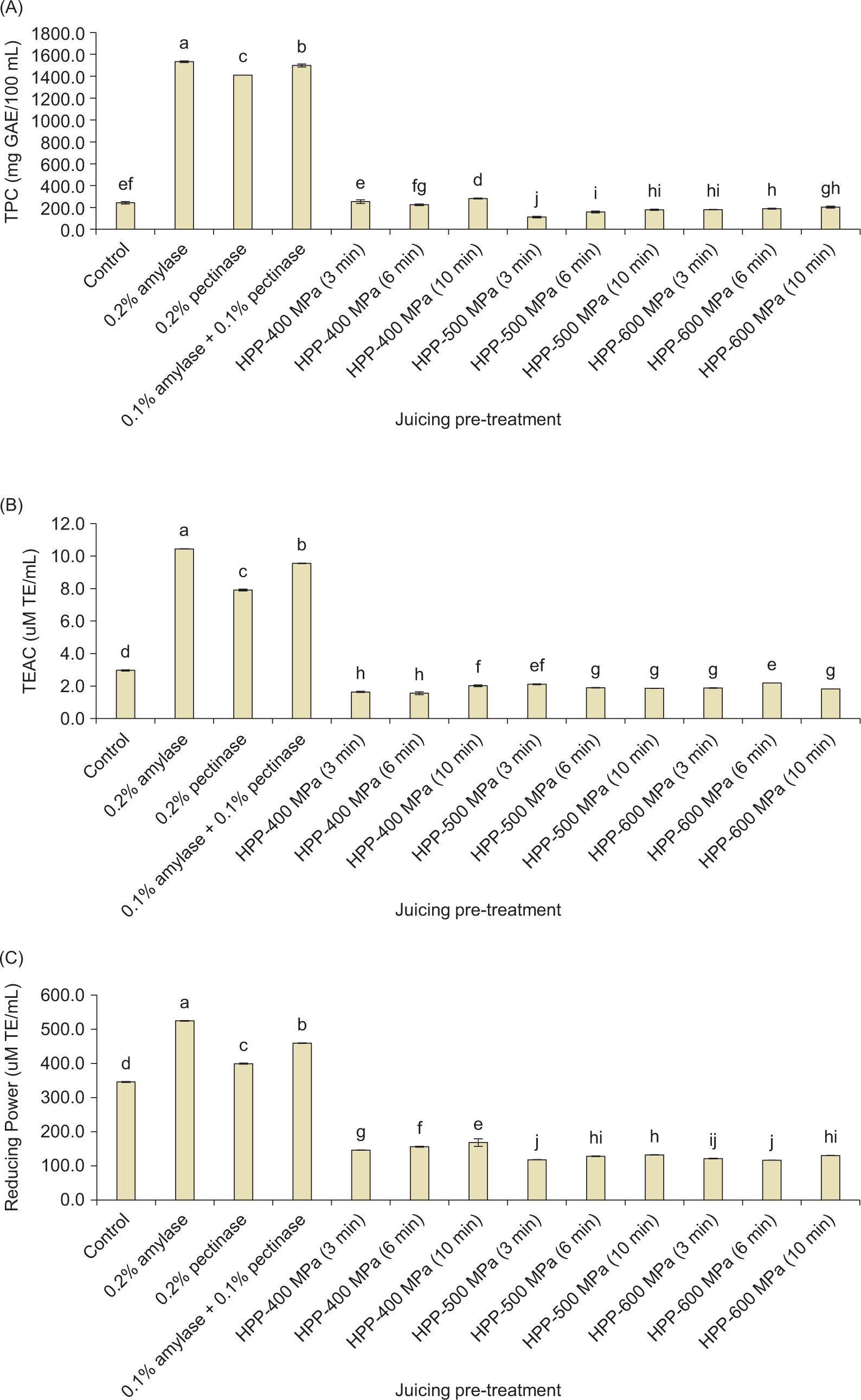
Enzyme-assisted treatments significantly increased TPC compared with both control and HPP samples (p < 0.05; Figure 4A). The highest TPC occurred with 0.2% amylase, followed by mixed enzyme and 0.2% pectinase treatments. Enzymatic hydrolysis of polysaccharides facilitates the release of bound phenolics otherwise trapped within the cell walls. Amylase primarily attacks starch, while pectinase degrades the middle-lamella pectins, collectively enhancing mass transfer and phenolic liberation (Rocchetti et al., 2022). Similar improvements were observed by Zubaidi et al. (2025) in enzyme-treated grape juice.
Figure 4. Effect of different juicing pre-treatments using high-pressure processing (HPP) and enzyme maceration on (A) total phenolic content (TPC), (B) Trolox equivalent antioxidant capacity (TEAC), and (C) ferric reducing antioxidant power (FRAP) of jaboticaba juice.
In contrast, HPP caused a significant reduction in TPC, particularly above 500 MPa. High pressure may induce oxidation or polymerization of phenolics because of transient oxygen exposure and mechanical stress (Chen et al., 2024). Furthermore, disruption of phenolic–macromolecule interactions may reduce extractable phenolics (Guo et al., 2024; Navarro-Baez et al., 2022). Notably, TPC showed strong negative correlations with PPO (r = −0.987) and POD (r = −0.972) activities in enzyme-treated samples, confirming that enzyme inactivation contributes to phenolic preservation. These findings suggest that enzymatic maceration is superior to HPP for phenolic recovery, highlighting its value as a low-energy, SDG 13-aligned approach that enhances bioactive yield while minimizing processing stress.
Antioxidant activities
The trends in antioxidant capacity (TEAC and FRAP; Figures 4B and 4C) reflected those of TPC. Enzyme-assisted maceration, especially 0.2% amylase produced the highest TEAC and reducing power values (p < 0.05). This increase reflected improved extraction and solubilization of antioxidant phenolics and anthocyanins because of enzymatic cell wall disruption. The released phenolics served as potent radical scavengers and reducing agents (Streimikyte et al., 2022). Similar enhancements in antioxidant activity were reported by Zubaidi et al. (2025) in enzyme-treated grape juice.
In contrast, antioxidant activity declined with increasing HPP intensity, consistent with the concurrent loss of phenolics and anthocyanins. Pressure-induced molecular rearrangements and oxidation under high shear conditions potentially compromised antioxidant efficacy (Guo et al., 2024). Significant positive correlations between reducing power and TPC (r = 0.818) and between reducing power and total anthocyanins (r = 0.716) in HPP-treated samples reaffirmed the dependency of antioxidant capacity on phenolic content. Overall, amylase-based maceration markedly improved the functional quality of jaboticaba juice, validating enzyme-assisted extraction as a sustainable and efficient strategy for producing antioxidant-rich beverages.
Sugar composition
Table 2 summarizes the sugar composition (fructose, glucose, and sucrose) of jaboticaba juice after enzymatic and HPP treatments. The highest total sugar content (11.84 g/100 mL) occurred at 400 MPa for 3 min (p < 0.05), primarily because of higher fructose and glucose levels with detectable sucrose. Moderate pressure appears to facilitate sucrose release from vacuoles without complete hydrolysis, whereas at ≥500 MPa sucrose may convert to reducing sugars through enzymatic or nonenzymatic hydrolysis (Liu et al., 2014).
Table 2. Sugar composition of jaboticaba juice extract after different juicing pre-treatments, including high-pressure processing (HPP) and enzyme maceration, as quantified by HPLC.
| Juicing pre-treatment | Sugar (g/100 mL) | |||
|---|---|---|---|---|
| Fructose | Glucose | Sucrose | Total | |
| Control | 4.52 ± 0.19d,e | 3.21 ± 0.10e | 1.66 ± 0.04a | 9.39 ± 0.34d,e |
| 0.2% Amylase | 5.28 ± 0.09a,b | 5.00 ± 0.09a,b | <LOD | 10.28 ± 0.18b,c |
| 0.2% Pectinase | 5.11 ± 0.05b,c | 3.98 ± 0.03d | <LOD | 9.09 ± 0.07e |
| 0.1% Amylase + 0.1% pectinase | 5.34 ± 0.03a,b | 4.57 ± 0.08c | <LOD | 9.91 ± 0.11c,d |
| HPP-400 MPa (3 min) | 5.49 ± 0.00a | 4.80 ± 0.00b,c | 1.55 ± 0.00b | 11.84 ± 0.02a |
| HPP-400 MPa (6 min) | 4.36 ± 0.08e | 3.73 ± 0.02d | 1.28 ± 0.05c | 9.37 ± 0.01d,e |
| HPP-400 MPa (10 min) | 4.74 ± 0.08c,d | 4.43 ± 0.10c | 1.22 ± 0.06c | 10.39 ± 0.04b,c |
| HPP-500 MPa (3 min) | 4.32 ± 0.16e | 3.95 ± 0.06d | <LOD | 8.27 ± 0.21f |
| HPP-500 MPa (6 min) | 4.58 ± 0.04d,e | 4.57 ± 0.00c | <LOD | 9.16 ± 0.04e |
| HPP-500 MPa (10 min) | 4.78 ± 0.02c,d | 4.67 ± 0.03b,c | <LOD | 9.45 ± 0.02d,e |
| HPP-600 MPa (3 min) | 5.18 ± 0.13a,b | 4.97 ± 0.13a,b | <LOD | 10.16 ± 0.00b,c |
| HPP-600 MPa (6 min) | 5.40 ± 0.01a,b | 5.02 ± 0.16a,b | <LOD | 10.42 ± 0.14b,c |
| HPP-600 MPa (10 min) | 5.39 ± 0.10a,b | 5.28 ± 0.22a | <LOD | 10.68 ± 0.12b |
Notes: Values with the same superscript alphabetsa–f in each row are not significantly different (p < 0.05).
LOD: limit of detection; HPLC: high-performance liquid chromatography.
Enzymatic maceration also enhanced sugar release, but through different mechanisms. Amylase hydrolyzes α-1,4-glycosidic bonds in starch, generating glucose, maltose, and maltotriose (Ćorković et al., 2022), while pectinase primarily improves juice yield and clarity with limited sugar formation (Sharma et al., 2017). HPP at 600 MPa increased glucose content because of enhanced cell disruption and diffusion but eliminated sucrose, confirming its pressure sensitivity. Overall, both moderate-pressure HPP (400 MPa) and enzyme maceration improved sugar extraction efficiency, although through distinct physicochemical routes. These treatments support the production of naturally sweeter juices without added sugars, contributing to SDG 12 (Responsible Consumption) by promoting cleaner-label beverage processing.
PCA and correlogram
The PCA effectively discriminated between different juicing pre-treatments based on the compositional and functional attributes of jaboticaba juice. The score plot (Figure 5A) revealed a clear separation of samples along the first two principal components, with PC1 explaining 62.8% and PC2 20.9% of the total variance. The enzyme-treated samples were tightly clustered on the right side of the score plot, indicating homogeneity in their physicochemical and antioxidant characteristics. In contrast, the HPP-treated samples were more dispersed in the left and lower quadrants, reflecting higher variability in response to pressure–time combinations. The control sample was positioned near the enzyme-treated cluster but slightly displaced, suggesting an intermediate composition between untreated and processed juices.
Figure 5. (A) Score plot and (B) biplot of principal component analysis (PCA), (C) correlogram plot of enzyme maceration and (D) high-pressure processing (HPP). TA: titratable acidity; TSS: total soluble solid; PPO: polyphenol oxidase; POD: peroxidase; TPC: total phenolic content; TEAC: Trolox equivalent antioxidant capacity; ATC: anthocyanin.
Figure 5. (Continued) (C) correlogram plot of enzyme maceration and (D) high-pressure processing (HPP). TA: titratable -acidity; TSS: total soluble solid; PPO: polyphenol oxidase; POD: peroxidase; TPC: total phenolic content; TEAC: Trolox -equivalent antioxidant capacity; ATC: anthocyanin.
The biplot (Figure 5B) further illustrates that enzyme-treated samples were strongly associated with higher total anthocyanin content, TPC, and antioxidant parameters (TEAC and reducing power) as well as reduced PPO activity. These variables had high positive loadings on PC1, confirming that enzymatic maceration promoted cell wall degradation, enhanced bioactive compound release, and improved antioxidant potential. In contrast, the HPP-treated samples exhibited stronger associations with TA and TSS, as well as reduced POD activity, indicating that pressure treatment primarily influenced structural disintegration and enzyme inactivation rather than phenolic enhancement.
The correlogram analysis (Figures 5C and 5D) provides further insight into the interrelationships among quality attributes. Enzyme maceration produced stronger positive correlations (p < 0.05) among TPC, total anthocyanins, and antioxidant activities (TEAC and FRAP), coupled with negative correlations with PPO and POD residual activities. This indicates that phenolic and anthocyanin enrichment is closely linked to oxidative enzyme suppression, leading to improved functional stability. In contrast, the HPP correlogram displayed weaker associations among these parameters, suggesting that pressure intensity and duration independently affect biochemical traits without producing a synergistic enhancement of bioactive compounds.
Overall, PCA and correlation analyses corroborate the experimental results, confirming that enzyme-assisted maceration exerts a more coordinated influence on the compositional and antioxidant profile of jaboticaba juice, while HPP primarily drives physical cell disruption and enzymatic inactivation. These findings highlight the distinct mechanistic pathways by which the two nonthermal technologies modulate juice quality.
Conclusion
This study demonstrated that enzyme-assisted maceration, particularly using 0.2% amylase, was the most effective nonthermal pre-treatment for improving the anthocyanin yield, TPC, and antioxidant capacity of jaboticaba juice. The enzymatic hydrolysis of cell wall polysaccharides facilitated efficient pigment and phenolic release, while concurrently suppressing oxidative enzyme activity (PPO and POD), resulting in superior bioactive retention and functional quality. In contrast, HPP exerted a pressure-dependent effect on juice characteristics. While moderate pressures (≈400 MPa) enhanced sugar release and effectively reduced POD activity, higher pressures (>500 MPa) led to partial degradation of anthocyanins and phenolics because of pressure-induced oxidation and structural destabilization. Overall, both technologies offered viable green, nonthermal alternatives to conventional juice processing. Enzyme maceration is particularly advantageous for maximizing bioactive compound recovery, while moderate-pressure HPP serves as an effective complementary step for stabilization of juice and enhancement of sweetness. These findings provide a scientific basis for developing minimally processed, anthocyanin-rich functional beverages with improved nutritional and antioxidant properties. Although HPP was investigated independently in this study, combining HPP with enzymatic pre-treatment represents a promising strategy for future research. Such an integrated approach may promote more effective cell wall degradation and improved extraction efficiency while preserving thermolabile bioactives under nonthermal conditions.
Acknowledgments
The authors acknowledged the financial support received from Universiti Putra Malaysia under the grant with Project No. GP-IPS/2024/9788600 and research initiative support from the University Driven Research Programme (UDRP). The authors also extended sincere appreciation to John Soo from Jabo Plantation Sdn. Bhd. for supplying jaboticaba fruit, and Agro-Biotechnology Institute (ABI), Malaysia for providing necessary facilities and technical assistance.
Mandatory Disclosure on Use of Artificial Intelligence
The authors declare that AI-assisted tools were used as follows: ChatGPT (OpenAI) for grammar checking and rephrasing of the manuscript text. All references have been manually verified for accuracy and relevance.
Author Contributions
Nor Azwan Haniff Kamarol Zaman: formal analysis, writing – original draft preparation, visualization, investigation. Giroon Ijod, Nur Izzati Mohamed Nawawi, and Nur Addina Mohamad Rosli: investigation, data curation, and software analysis. Chong Gun Hean and Noranizan Mohd Adzahan: conceptualization, review and editing, and supervision. Ezzat Mohamad Azman: conceptualization, review and editing, methodology, validation, supervision, and funding acquisition.
Conflict of Interest
No conflict of interest was declared.
REFERENCES
Abera, G. 2019. Review on high-pressure processing of foods. Cogent Food Agric. 5(1):1568725. 10.1080/23311932.2019.1568725
Azman, E.M., Yusof, N., Chatzifragkou, A., and Charalampopoulos, D. 2022. Stability enhancement of anthocyanins from blackcurrant (Ribes nigrum L.) pomace through intermolecular copigmentation. Molecules. 27(17):5489. 10.3390/molecules27175489
Barba, F.J., Terefe, N.S., Buckow, R., Knorr, D., and Orlien, V. 2015. New opportunities and perspectives of high-pressure treatment to improve health and safety attributes of foods. A review. Food Res Int. 77:725–742. 10.1016/j.foodres.2015.05.015
Chen, Z., Świsłocka, R., Choińska, R., Marszałek, K., Dąbrowska, A., Lewandowski, W., and Lewandowska, H. 2024. Exploring the correlation between the molecular structure and biological activities of metal–phenolic compound complexes: research and description of the role of metal ions in improving the antioxidant activities of phenolic compounds. Int J Mol Sci. 25(21):11775. 10.3390/ijms252111775
Chua, L.S., Abd Wahab, N.S., and Soo, J. 2023. Water-soluble phenolics, flavonoids and anthocyanins extracted from jaboticaba berries using maceration with ultrasonic pretreatment. Food Chem Adv. 3:100387. 10.1016/j.focha.2023.100387
Ćorković, I., Gašo-Sokač, D., Pichler, A., Šimunović, J., and Kopjar, M. 2022. Dietary polyphenols as natural inhibitors of α-amylase and α-glucosidase. Life. 12(11):1692. 10.3390/life12111692
Daher, F.B., and Braybrook, S.A. 2015. How to let go: pectin and plant cell adhesion. Front Plant Sci. 6:523. 10.3389/fpls.2015.00523
Dasaesamoh, R., Youravong, W., and Wichienchot, S. 2016. Optimization on pectinase extraction and purification by yeast fermentation of oligosaccharides from dragon fruit (Hyloceusundatus). Int Food Res J. 23(6):2601.
de Barros, G.L., Silva, F.T.S., Teixeira, R.S., Wagner, J.G., Rombaldi, C.V., Vizzotto, M., Ubeyitogullari, A., and Nora, L. 2024. Anthocyanin extraction methods: synthesis of morpho-anatomical knowledge for decision-making based on decision-tree. Int. J. Food Prop. 27(1):1315–1346. 10.1080/10942912.2024.2409893
Dhenge, R., Rinaldi, M., Rodolfi, M., Barbanti, D., and Ganino, T. 2023. Modification of structural characteristics of vegetables by high-pressure processing: a review. Food Biosci. 56:103407. 10.1016/j.fbio.2023.103407
Enaru, B., Drețcanu, G., Pop, T.D., Stǎnilǎ, A., and Diaconeasa, Z. 2021. Anthocyanins: factors affecting their stability and degradation. Antioxidants. 10(12):1967. 10.3390/antiox10121967
Fernandes, F.A., Fonteles, T.V., Rodrigues, S., de Brito, E.S., and Tiwari, B.K. 2020. Ultrasound-assisted extraction of anthocyanins and phenolics from jabuticaba (Myrciariacauliflora) peel: kinetics and mathematical modeling. J Food Sci Technol. 57:2321–2328. 10.1007/s13197-020-04270-3
Fernandes, I.D.A.A., Maciel, G.M., Maroldi, W.V., Bortolini, D.G., Pedro, A.C., and Haminiuk, C.W.I. 2022. Bioactive compounds, health-promotion properties and technological applications of jabuticaba: a literature overview. Measurement Food. 8:100057. 10.1016/j.meafoo.2022.100057
Geraldi, M.V., Cazarin, C.B.B., Dias-Audibert, F.L., Pereira, G.A., Carvalho, G.G., Kabuki, D.Y., ..., and Júnior, M.R.M. 2021. Influence of high isostatic pressure and thermal pasteurization on chemical composition, color, antioxidant properties and sensory evaluation of jabuticaba juice. Food Sci Technol (LWT). 139:110548. 10.1016/j.lwt.2020.110548
González-Cebrino, F., Durán, R., Delgado-Adámez, J., Contador, R., and Ramírez, R. 2013. Changes after high-pressure processing on physicochemical parameters, bioactive compounds, and polyphenol oxidase activity of red flesh and peel plum purée. Innov Food Sci Emerg Technol. 20:34–41. 10.1016/j.ifset.2013.07.008
Guo, W., Mehrparvar, S., Hou, W., Pan, J., Aghbashlo, M., Tabatabaei, M., and Rajaei, A. 2024. Unveiling the impact of high-pressure processing on anthocyanin-protein/polysaccharide interactions: a comprehensive review. Int J Biol Macromol. 270:132042. 10.1016/j.ijbiomac.2024.132042
Ijod, G., Nawawi, N.I.M., Sulaiman, R., Adzahan, N.M., Anwar, F., and Azman, E.M. 2024. Blanching-induced changes in polyphenol oxidase, antioxidants and phenolic profile of mangosteen pericarp. Food Technol Biotechnol (FTB). 62(4):465–479. 10.17113/ftb.62.04.24.8513
Ijod, G., Nawawi, N.I.M., Sulaiman, R., Khalid, N.I., Anwar, F., Adzahan, N.M., and Azman, E.M. 2025. Inactivation of polyphenol oxidase and peroxidase activity in mangosteen pericarp via blanching: correlation between anthocyanins and enzyme activities. Int J Food Sci Technol. 60(1):vvae010. 10.1093/ijfood/vvae010
Inada, K.O.P., Leite, I.B., Martins, A.B.N., Fialho, E., Tomás-Barberán, F.A., Perrone, D., and Monteiro, M. 2021. Jaboticaba berry: a comprehensive review on its polyphenol composition, health effects, metabolism, and the development of food products. Food Res Int. 147:110518. 10.1016/j.foodres.2021.110518
Ismail, N.H.S., Nawawi, N.I.M., Ijod, G., Anzian, A., Ismail-Fitry, M.A., Ahmad, N.H., Adzahan, N.M., and Azman, E.M. 2024. Shelf life and quality assessment of pasteurised red dragon fruit (Hylocereus polyrhizus L.) purée: comparative study of high-pressure and thermal processing. Int Food Res J. 31(2). 10.47836/ifrj.31.2.22
Jamaluddin, F., Noranizan, M.A., Mohamad Azman, E., Mohamad, A., Yusof, N.L., and Sulaiman, A. 2022. A review of clean-label approaches to chillipaste processing. Int J Food Sci Technol. 57(2):763–773. 10.1111/ijfs.15293
Jia, D., Xu, Z., Chen, L., Huang, Q., Huang, C., Tao, J., ..., and Xu, X. 2023. Analysis of organic acid metabolism reveals citric acid and malic acid play major roles in determining acid quality during the development of kiwifruit (Actinidia eriantha). J Sci Food Agric. 103(12):6055–6069. 10.1002/jsfa.12678
Li, F., Foucat, L., and Bonnin, E. 2021. Effect of solid loading on the behaviour of pectin-degrading enzymes. Biotechnol Biofuels. 14(1):107. 10.1186/s13068-021-01957-3
Liu, Y., Deng, J., Zhao, T., Yang, X., Zhang, J., and Yang, H. 2024. Bioavailability and mechanisms of dietary polyphenols affected by nonthermal processing technology in fruits and vegetables. Curr Res Food Sci. 8:100715. 10.1016/j.crfs.2024.100715
Liu, F., Li, R., Wang, Y., Bi, X., and Liao, X. 2014. Effects of high hydrostatic pressure and high-temperature short-time on mango nectars: changes in microorganisms, acid invertase, 5-hydroxymethylfurfural, sugars, viscosity, and cloud. Innov Food Sci Emerg Technol. 22:22–30. 10.1016/j.ifset.2013.11.014
Marquetti, C., Santos, T.B.D., Kaipers, K.F.C., Bӧger, B.R., Tonial, I.B., Wagner Junior, A., and Prado, N.V.D. 2018. Jaboticaba skin flour: analysis and sustainable alternative source to incorporate bioactive compounds and increase the nutritional value of cookies. Food Sci Technol. 38:629–638. 10.1590/fst.06717
Marsol-Vall, A., Kelanne, N., Nuutinen, A., Yang, B., and Laaksonen, O. 2021. Influence of enzymatic treatment on the chemical composition of lingonberry (Vaccinium vitis-idaea) juice. Food Chem. 339:128052. 10.1016/j.foodchem.2020.128052
Marszałek, K., Doesburg, P., Starzonek, S., Szczepańska, J., Woźniak, Ł., Lorenzo, J.M., ..., and Barba, F.J. 2019. Comparative effect of supercritical carbon dioxide and high-pressure processing on structural changes and activity loss of oxidoreductive enzymes. J CO2 Util. 29:46–56. 10.1016/j.jcou.2018.11.007
Marszałek, K., Woźniak, Ł., Kruszewski, B., and Skąpska, S. 2017. The effect of high-pressure techniques on the stability of anthocyanins in fruit and vegetables. Int J Mol Sci. 18(2):277. 10.3390/ijms18020277
Navarro-Baez, J.E., Martínez, L.M., Welti-Chanes, J., Buitimea-Cantúa, G.V., and Escobedo-Avellaneda, Z. 2022. High-hydrostatic pressure to increase the biosynthesis and extraction of phenolic compounds in food: a review. Molecules. 27(5):1502. 10.3390/molecules27051502
Nawawi, N.I.M., Khushairi, N.A.A.A., Ijod, G., and Azman, E.M. 2025. Extraction of anthocyanins and other phenolics from dried blackcurrant (Ribes nigrum L.) pomace via ultrasonication. Sustain Chem Environ. 9:100208. 10.1016/j.scenv.2025.100208
Paludo, M.C., Colombo, R.C., Teixeira Filho, J., Hermosín-Gutiérrez, I., Ballus, C.A., and Godoy, H.T. 2019. Optimizing the extraction of anthocyanins from the skin and phenolic-compounds from the seed of jabuticaba fruits (Myrciariajabuticaba (Vell.) O. Berg) with ternary mixture experimental designs. J Braz Chem Soc. 30(7):1506–1515. 10.21577/0103-5053.20190047
Ramos Boldori, J., de Los Santos Moraes, L., de Freitas Rodrigues, C., Limana Tambara, A., and Casagrande Denardin, C. 2023. Involvement of the DAF-16/FOXO pathway in the antioxidant activity of the jaboticaba (Myrciaria trunciflora) extract against various stressors using caenorhabditis elegans. Chem Biodiversity. 20(5):e202201046. 10.1002/cbdv.202201046
Rocchetti, G., Gregorio, R.P., Lorenzo, J.M., Barba, F.J., Oliveira, P.G., Prieto, M.A., ..., and Lucini, L. 2022. Functional implications of bound phenolic compounds and phenolics–food interaction: a review. Compr Rev Food Sci Food Saf. 21(2):811–842. 10.1111/1541-4337.12921
Sehrawat, R., Kaur, B.P., Nema, P.K., Tewari, S., and Kumar, L. 2021. Microbial inactivation by high-pressure processing:-principle, mechanism and factors responsible. Food Sci Biotechnol. 30(1):19–35. 10.1007/s10068-020-00831-6
Sharma, H.P., Patel, H., and Sugandha. 2017. Enzymatic added extraction and clarification of fruit juices—a review. Crit Rev Food Sci Nutr. 57(6):1215–1227. 10.1080/10408398.2014.977434
Streimikyte, P., Viskelis, P., and Viskelis, J. 2022. Enzymes-assisted extraction of plants for sustainable and functional applications. Int J Mol Sci. 23(4):2359. 10.3390/ijms23042359
Tapre, A.R., and Jain, R.K. 2014. Pectinases: enzymes for fruit-processing industry. Int Food Res J. 21(2):447.
Wang, Y., Ral, J.P., Saulnier, L., and Kansou, K. 2022. How does starch structure impact amylolysis? Review of current strategies for starch digestibility study. Foods. 11(9):1223. 10.3390/foods11091223
Yang, X., Ding, H., Luo, S., Sun, X., Wang, N., and Wang, Y. 2022. Comparison of high hydrostatic pressure and thermal processing on microorganisms and quality of anthocyanin-rich fruit puree. Front Food Sci Technol. 2:911283. 10.3389/frfst.2022.911283
Yilmaz, N., Kodama, Y., and Numata, K. 2019. Revealing the architecture of the cell wall in living plant cells by bioimaging and enzymatic degradation. Biomacromolecules. 21(1):95–103. 10.1021/acs.biomac.9b00979
Yuan, B., Danao, M.G.C., Stratton, J.E., Weier, S.A., Weller, C.L., and Lu, M. 2018. High-pressure processing (HPP) of aronia berry purée: effects on physicochemical properties, microbial counts, bioactive compounds, and antioxidant capacities. Innov Food Sci Emerg Technol. 47:249–255. 10.1016/j.ifset.2018.03.009
Zhang, W., Kong, J., Zhang, M., Chen, Y., Yu, Q., Shen, M., and Xie, J. 2024. Starch-anthocyanins complex: characterization, digestibility, and mechanism. Food Hydrocoll. 151:109797. 10.1016/j.foodhyd.2024.109797
Zubaidi, M.A., Czaplicka, M., Kolniak-Ostek, J., and Nawirska-Olszańska, A. 2025. Effect of different enzyme treatments on juice yield, physicochemical properties, and bioactive compound of several hybrid grape varieties. Molecules. 30(3):556. 10.3390/molecules30030556